
 ES
ES EN
EN RU
RU SA
SAA disc brake chamber is a pneumatic actuator that converts compressed air pressure into pushing force for an air disc brake on trucks, tractors, and trailers. The key point: disc brake chambers work without a slack adjuster, so they are more compact, need no manual brake adjustment, and require a different inspection routine than drum brake chambers. The most common sizes are Type 16, Type 20, Type 24, and Type 30, and the right replacement must match the effective area, stroke, port orientation (air inside or air outside), and whether the chamber includes a spring brake function.
Контент
- 1 What Is a Disc Brake Chamber?
- 2 Disc Brake Chamber vs. Drum Brake Chamber
- 3 Common Disc Brake Chamber Sizes and Specifications
- 4 Air Inside vs. Air Outside (IBV) Disc Brake Chambers
- 5 Signs of a Failing Disc Brake Chamber
- 6 How to Choose the Right Disc Brake Chamber
- 7 Replacement and Installation Tips
- 8 Frequently Asked Questions
What Is a Disc Brake Chamber?
A disc brake chamber is the final pneumatic component in an air disc brake system. It converts the compressed air pressure from the brake valve into mechanical force that clamps the brake pads against the rotor. When air enters the chamber, a rubber diaphragm pushes a rod forward; when the driver releases the brake, internal return springs pull the rod back and the brake releases.
Disc brake chambers are used on air disc brake foundations, which are common on steer axles and increasingly fitted to drive and trailer axles. Because the push rod acts directly on the caliper, there is no S-cam and no slack adjuster in the system, which is why the chamber itself is the main actuation part that wears and needs replacement.
Disc Brake Chamber vs. Drum Brake Chamber
The difference between disc and drum brake chambers is not just the housing shape. It changes the actuation layout, the adjustment procedure, and the inspection points.
| Feature | Disc brake chamber | Drum brake chamber |
|---|---|---|
| Actuation | Push rod drives the caliper directly | Push rod moves a slack adjuster and S-cam |
| Slack adjuster | Not present | Required |
| Brake adjustment | No manual adjustment needed | Manual or automatic slack adjustment |
| Physical size | More compact | Larger and bulkier |
| Inspection focus | Air leaks, pad wear, rotor condition | Push rod stroke, lining wear, cam bushing |
| Typical application | Air disc brake axles | Drum brake axles |
If the vehicle originally came with air disc brakes, the replacement must be a disc brake chamber. The mounting pattern, port position, and push rod length are not interchangeable with drum brake types.
Common Disc Brake Chamber Sizes and Specifications
Disc brake chambers are classified by the diaphragm effective area in square inches. A Type 16 chamber has a 16 in² diaphragm, while a Type 30 chamber has a 30 in² diaphragm, and larger sizes deliver more clamping force for heavier axles.
| Type | Effective area | Typical stroke | Common use |
|---|---|---|---|
| Type 16 | 16 in² | T16 | Steer axles and lighter vehicles |
| Type 20 | 20 in² | T20 | Steer and light drive axles |
| Type 24 | 24 in² | T24 | Drive axles and medium heavy trucks |
| Type 30 | 30 in² | T30 | Heavy drive and trailer axles |
The stroke is part of the model code as well. For example, a FA1018A-T30 disc brake chamber combines a Type 30 effective area with a T30 stroke. Fitting a chamber with the wrong stroke can limit caliper travel, causing weak braking or brake drag.
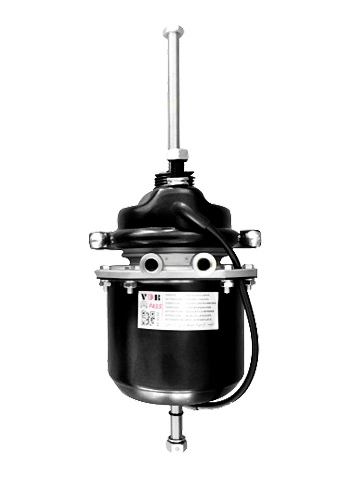 T20/24DP Disc Brake Chamber with Type 24 Effective AreaThis disc brake chamber is paired with a T30 stroke in the preceding example, while this model uses a T24 stroke, so verify your caliper travel requirements to avoid weak braking or drag.View Product →
Air Inside vs. Air Outside (IBV) Disc Brake Chambers
Disc brake chambers with an integrated breather valve (IBV) are available in two port configurations: air inside and air outside. The configuration determines the position of the service air inlet on the chamber, which affects hose routing and clearance inside the wheel area.
An air-inside chamber has the air inlet facing toward the vehicle centerline; an air-outside chamber has it facing outward. There is no performance advantage of one over the other; the correct choice is the one that matches the original chamber and the caliper layout on the axle.
If you fit the wrong orientation, the air hose may take an aggressive bend and chafe against the suspension, which eventually causes a leak. Always compare the old chamber before removal and confirm both the port position and the breather orientation when ordering.
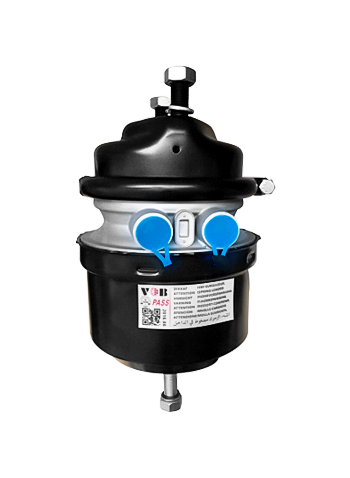 T16/24DP Disc Brake Chamber with Inside Air Port and IBVThis chamber features an air-inside configuration with integrated breather valve, helping reduce hose routing issues and chafing against suspension components in tight wheel areas.View Product →
Signs of a Failing Disc Brake Chamber
Most disc brake chamber failures show up as air leaks or poor brake release, and they are relatively easy to identify if you know what to check.
- Audible air hiss while the brake is applied or released, which usually indicates a torn diaphragm, leaking seal, or loose port fitting.
- Brake drag: the wheel is hard to rotate by hand after the brake is released, often caused by a stretched push rod, broken return spring, or misaligned chamber.
- Uneven braking: the vehicle pulls to one side, meaning one chamber delivers less force than the other side.
- Visible damage: cracked housing, bent push rod, corroded or broken mounting bolts.
- Moisture or oil around the breather: contaminated air can damage the diaphragm and shorten chamber life.
On disc brakes, also check pad thickness and rotor condition whenever the chamber is serviced. A seized caliper or severely worn pads can overload the chamber and cause premature failure.
How to Choose the Right Disc Brake Chamber
Start with the number stamped on the old chamber, then verify the physical dimensions and port orientation. If the marking is worn, measure the clamp diameter and the push rod stroke to identify the type.
- Confirm the brake foundation is air disc; a disc brake chamber will not mount on a drum brake axle.
- Identify the type and stroke from the markings, for example Type 30 with a T30 stroke.
- Determine whether the chamber is air-inside or air-outside and note the port size.
- Check if it is a service-only chamber or a spring brake combination chamber with parking brake function.
- Verify the mounting bolt pattern and push rod length against the original part.
- Buy from a supplier that covers the full brake system, so the chamber, slack adjusters, and control valves are matched to the same application.
When you source from a manufacturer that covers the full commercial vehicle brake system, you can confirm compatibility with the rest of the air circuit in one place instead of mixing parts from different sources.
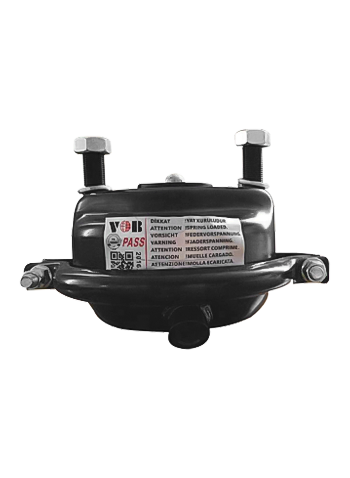 Heavy Duty T30 Disc Brake Chamber for Trucks and TrailersSourced from a manufacturer covering the full commercial vehicle brake system, this heavy-duty chamber supports compatibility with the rest of the air circuit in one place.View Product →
Replacement and Installation Tips
Replacing a disc brake chamber is a straightforward job, but a few precautions prevent common problems such as brake drag and uneven wear.
- Exhaust all air pressure from the system and chock the wheels before loosening any fitting.
- Support the chamber while removing the mounting bolts so the push rod does not bend.
- Replace chambers in pairs on the same axle whenever practical; a new chamber on one side and a worn one on the other can cause uneven braking.
- Inspect the caliper slide pins, pads, and rotor while the chamber is off.
- Tighten the fasteners to the manufacturer's torque specification and recheck them after the first few brake applications.
- Pressurize the system and check for leaks at the ports and around the diaphragm flange before returning the vehicle to service.
After installation, cycle the service brake and the parking brake several times. A disc brake chamber should not need any mechanical adjustment; if the brake does not release cleanly, inspect the chamber stroke, the caliper, and the air supply instead of trying to adjust the chamber itself.
Frequently Asked Questions
Do disc brake chambers need adjustment?
No. Because a disc brake foundation has no slack adjuster, there is nothing to adjust on the chamber. If braking performance changes, inspect the chamber, pads, rotor, and air system components such as the relay valve and foot brake valve.
How do I identify the size of a disc brake chamber?
Look for the type number on the housing or model tag. If the marking is missing, measure the diaphragm clamp diameter and the push rod stroke, then match those dimensions to the manufacturer's specification table.
Can I fit a larger disc brake chamber for more braking force?
Not without verifying the caliper and the vehicle's brake design. A larger effective area produces more force, but the caliper, rotor, and air supply must handle it, and the stroke must remain correct. Changing chamber size on one axle without approval can also affect brake balance.
What causes brake drag after a disc brake chamber replacement?
The usual causes are a stretched push rod, wrong stroke length, misaligned mounting, a sticking caliper, or air that cannot fully exhaust. Check these points in that order with the wheels raised and the brakes released.
When should I choose an air-inside or an air-outside chamber?
Choose whichever matches the original installation. The port position changes how the air line routes, and matching the original prevents hose chafing, clearance issues, and installation delays.

 Свяжитесь с нами